
Introducing Buying Power Weighted Probability of Profit

September 29, 2026
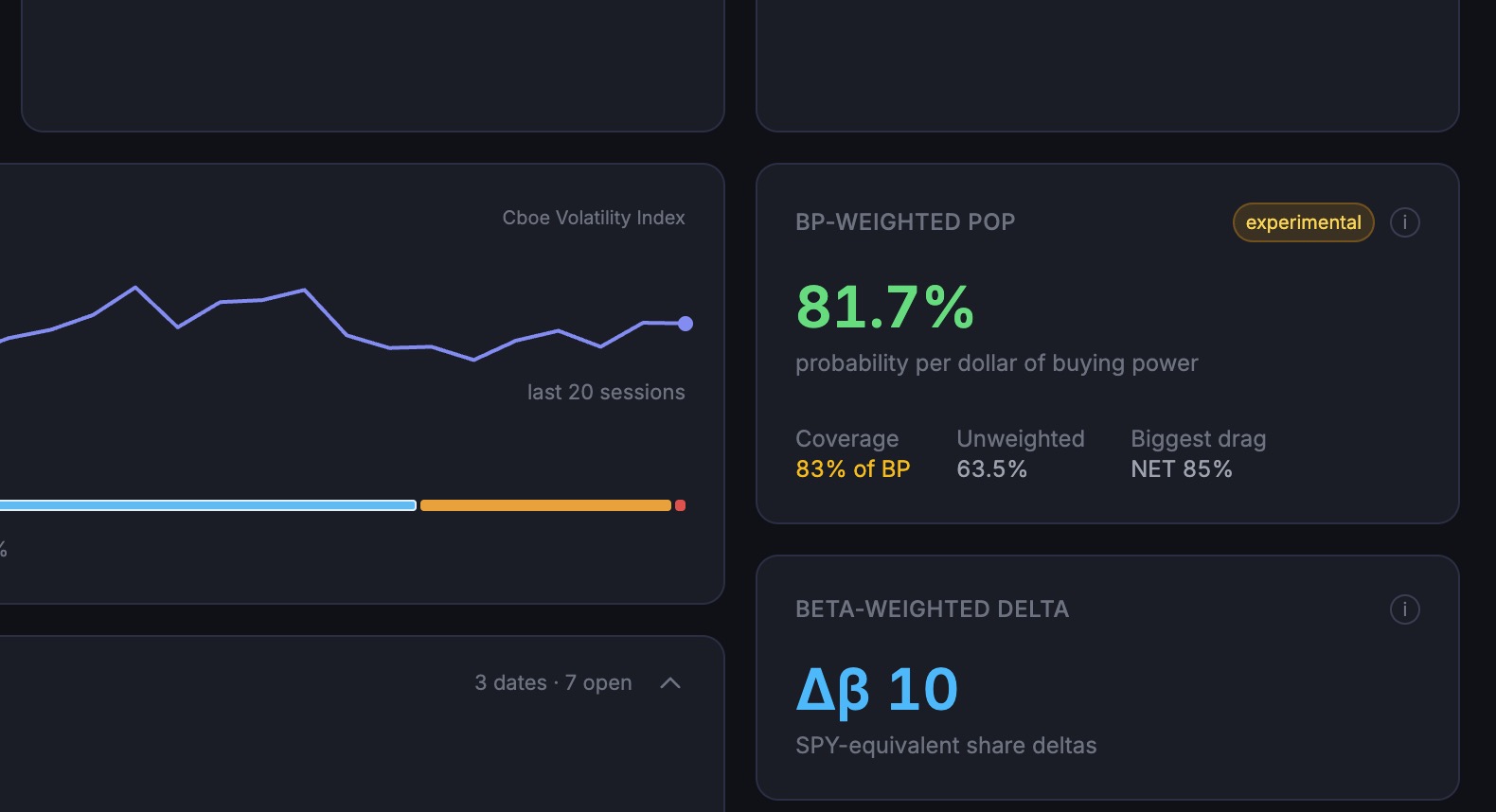
Every risk framework you borrow from someone else comes with judgment calls baked in that you didn’t make yourself. As I’ve mentioned before, ours comes from The Unlucky Investor’s Guide to Options Trading by Julia Spina, and for the most part I trust it completely — it’s backtested, it’s disciplined, and it’s kept my own portfolio out of trouble so far. But there’s one rule inside it I’ve never been fully at peace with, and today’s post — Ctrl-Trade’s first official product update — is about the number we built to fix it: buying power weighted probability of profit.
How do I read undefined vs. defined risk?
The rule in question caps how much of your buying power should sit in defined-risk trades — positions with a hedge that caps your max loss, like an iron condor — at 25%. The rest, at least 75%, is supposed to go to undefined-risk trades: positions like a strangle, a naked put, or a naked call.
The first time you hear it, it sounds backwards — shouldn’t capping your downside be the safer choice? But the book’s reasoning holds up. Undefined-risk trades carry a higher probability of profit (POP) — the statistical odds a trade closes profitably. They’re simpler to close early, since you only have to buy back one leg instead of unwinding two. And they’re generally easier to manage day to day. Defined-risk trades, by contrast, have a lower POP and are more fiddly to exit, because you have to buy back both the short leg and the protective one.
There’s also another argument in favor of undefined-risk trades: they often carry a better expected value (EV) — the average outcome you’d expect if you repeated the trade many times over. That’s a topic that deserves its own post, but for now, know that mechanically repeating these trades has historically been profitable on average.
So the logic behind the rule is sound. What’s always bothered me is that it’s a proxy: it measures your portfolio by a percentage split between two risk categories, when what you actually care about is your probability of profit. Those two things usually move together — but not always, and the gap between them is where this new number lives.
Where the split breaks
Here’s a real example from my own portfolio. Right now I sit at 61% undefined risk — well below the 75% target. But my portfolio’s actual weighted probability of profit is 71%, which is a solid number by any measure. Going purely by the ratio, I’d look like I’m “failing” the guideline. Going by what actually matters, I’m not.
Now flip it. On a demo portfolio, I’m sitting at 87% undefined risk — comfortably clearing the bar. But the probability of profit on that same portfolio is only 63%. Why the gap? Because one of the trades in there is a straddle — selling a put and a call at the same strike. It’s still technically undefined risk, so it counts in the “good” column of the ratio. But a straddle has a much narrower range of outcomes that actually make money compared to something like a strangle or an iron condor, so its individual POP is a lot lower. Delete that one trade, and the portfolio’s probability of profit jumps back up to almost 70% — while the undefined-risk ratio actually goes down.
My read of it was never “put at least 75% into undefined risk.” It’s “cap how much buying power sits in high-risk, low-probability trades at 25%.” Undefined risk was just the easiest category to reach for at the time, not the real target. That’s exactly why buying power weighted POP is useful: it lets you evaluate your portfolio’s probability of profit directly, without first having to sort every trade into “defined” or “undefined” at all.
Buying power weighted probability of profit
So instead of treating every trade as an equal vote toward a risk-category percentage, we weight each trade’s individual POP by how much buying power it actually ties up, then aggregate that across your whole portfolio into a single number:
In plain terms: take each trade’s probability of profit, multiply it by that trade’s buying power requirement (BPR) — how much capital it actually ties up — add all of those together, then divide by your total buying power committed across every open trade. It’s the same idea as a weighted average grade in school, where a final exam counts for more than a quiz: here, a trade counts for more the more capital it commits.
That weighting is the whole point. A $10,000 trade with a 50% POP should move your portfolio number a lot more than a $500 trade with the same 50% POP, because it’s putting far more of your actual capital behind those odds. A simple average across trades — or even a simple average across risk categories — can’t tell the two apart. Weighting by buying power can.
The result is a portfolio-wide probability of profit sitting right next to the per-trade POP you already see in your trades list — one number that tells you, across everything you’re holding right now, roughly how the odds are stacked in your favor.
Where this goes next
I’m marking this one experimental, for a few honest reasons. It’s our first KPI that didn’t come from the book or from TastyTrade’s research — we built it ourselves. As far as I know, no broker currently reports anything like it. I backtested it before shipping and the results held up well, but I want to run it against my own live portfolio for a few months before I’d call it proven, and I’ll share informal updates on how it holds up as I go.
The plan isn’t to replace the undefined-vs-defined capital allocation rule — it’s to add BP-weighted POP to the risk framework alongside it. The category split is still a reasonable guardrail on its own; this just gives you the sharper number to actually optimize for underneath it, especially if you’re not comfortable running heavily undefined risk or can’t manage the extra attention it demands. You can build a portfolio with a strong probability of profit without forcing yourself toward a specific undefined-risk quota that doesn’t fit how you want to trade.
If you’re already in the beta, you won’t see it by default yet — it’s behind a toggle in your global settings for now, alongside a couple of debug-only figures I’ll likely strip out soon to keep just the one number that matters. If you’re not in the beta yet, we’re still welcoming testers.
Trade Well,
Francesco
Software Developer & Options Trader
Creator of Ctrl-Trade. A software developer of 15+ years who brings a programmer’s discipline — clear rules, data and backtesting — to options trading, and writes about what he learns in plain English.