Selling vs Buying Options: Why Sellers Have the Edge

May 14, 2026

In my first blog post, I already introduced the main concept that got me hooked to options: the natural statistical edge that options sellers have against options buyers. This is probably an oversimplification, maybe even a misleading metric without a proper explanation — but I promise by the end of this article it will make way more sense.
Before diving in, let’s have a refresher on what an option actually is:
An option is a financial derivative that gives the buyer the right, but not the obligation, to buy or sell an underlying asset at a specific price on (or before) a specific date.
So, sellers and buyers exchange options contracts with different purposes:
- Buyers usually seek insurance against sudden market movements, or to speculate against them
- Sellers try to profit from this mechanics, relying on the fact that market volatility is often overstated, and “crash protection” is overpriced most of the time (but not always).
This phenomenon is called the “Volatility Risk Premium” (academically, it’s often referred to as the “Variance Risk Premium”), and is one of the most documented behaviors in financial academic research.
The Game of Buying Options
If the above definition sounds a bit abstract, here is a clear example:
- Bob owns 100 shares of Acme Inc and fears that the stock may crash
- Acme Inc is currently trading at $100 per share, but Bob bought years ago at $60 — he already made a nice profit
- Bob wants peace of mind to lock in his profit at $90 per share, so he buys a Put Option from Alice, for $1.50 per share
At this point, a few things may happen:
- Acme Inc keeps rising — Alice keeps the premium Bob paid as “insurance” against a crash
- Acme Inc falls but stays above $90 (the strike price) — same as above, Alice keeps the premium
- Acme Inc crashes — Bob has the right (but not the obligation) to exercise his Put Option and sell his shares for $90, protecting his investment and locking in his accumulated profit
This is of course a simplified example, but a meaningful one for understanding the rationale behind buying put options. Options, and particularly put contracts, can act as an insurance policy for your shares or any underlying they are built upon.
The interesting fact is that, like the majority of insurance policies against illness, hurricanes and car crashes, options are rarely exercised. When they are, it’s a big payout — but the frequency is contained (depending on a few factors, of course). With options it’s pretty much the same. To borrow a nice metaphor from The Unlucky Investor’s Guide to Options Trading: buying options is like playing slot machines, selling options is like owning the slot machines.
And this brings us to the other side of the table: selling options.
The Game of Selling Options
In the above example, Alice sold a Put Option for $1.50 per share — but how can she sell something she doesn’t own? Bob was the one holding the shares!
She sold a cash-secured put, meaning that — until the option’s expiration date — she has to commit the capital of $90 per share in her brokerage account to be able to “deliver” the shares if the contract gets exercised. It’s not the only way to do it, as there are strategies that allow you to operate on margin, but let’s keep it simple for now.
The reason Alice was able to calibrate the risk and essentially control her chances of being profitable is that the strike price of $90 and the expiration date (say, 25 days out) were chosen by her. She could have sold at a strike of $85, collecting less premium but increasing her chances of success — or gone further out in time, collecting a higher premium but being exposed to more market events that could influence the price.
Alice set the terms of this trade. Bob agreed and bought.
There are many things you can do as an option seller to maximise your chances of profit and trade in a way that fits your risk tolerance — and there are metrics (the Greeks) that allow you to quickly understand what you’re facing in a trade.
One of the most useful is delta (∆). In practice, delta is widely used as a rough proxy for the probability of an option expiring in the money. A put with a delta of -0.15 has roughly an 85% chance of expiring worthless — which means an 85% probability of profit for the seller at current market conditions.
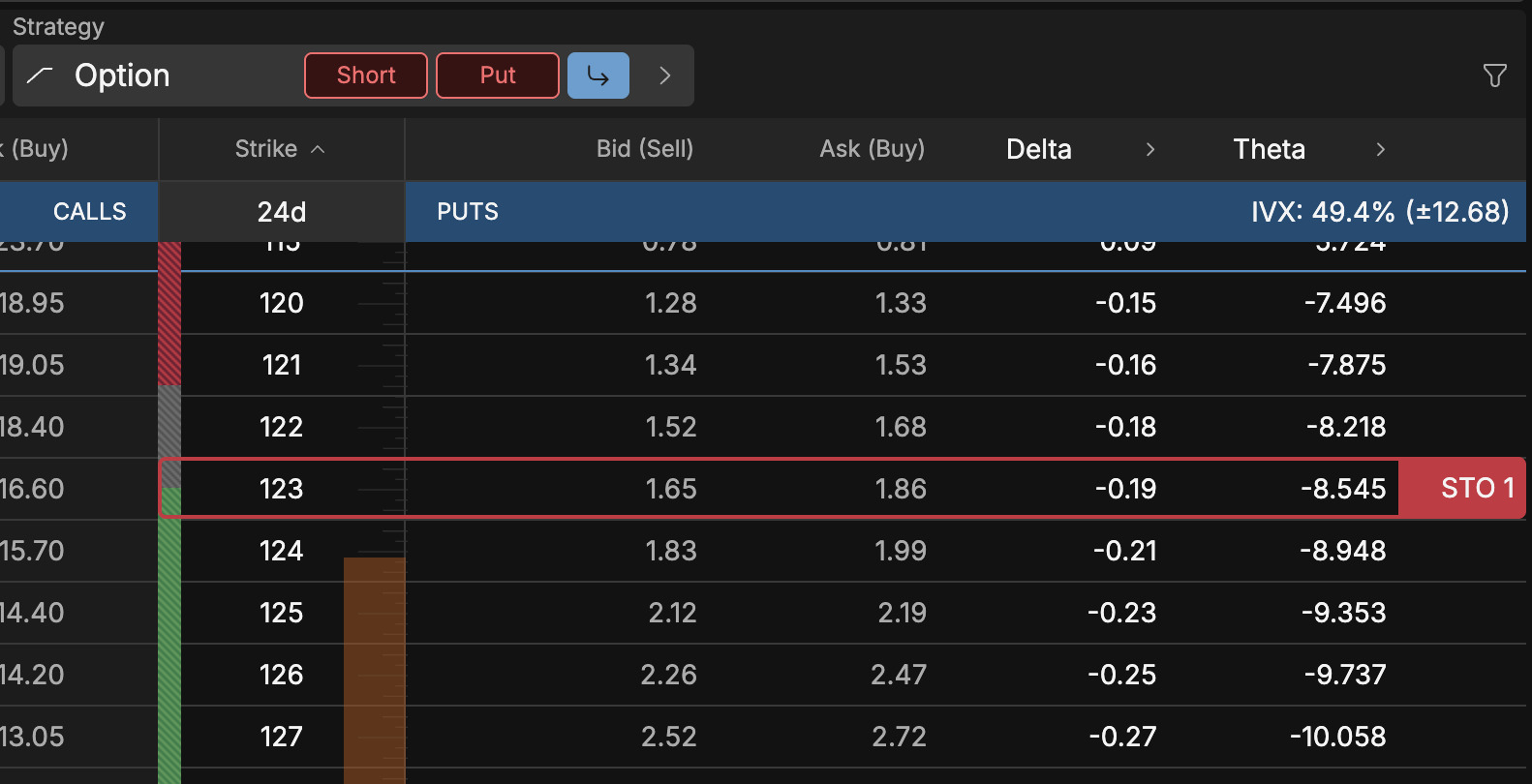
One important caveat, though, so you don’t lean on that number too hard: delta is a descriptive metric, not an edge in itself. It’s the probability the market is pricing right now, under current conditions — a snapshot that shifts as volatility and price move, not a fixed promise. And since every trader sees the same number, those odds are already baked into the premium you collect. If you want to watch this in motion, our implied volatility calculator lets you nudge the price or the days left and see delta shift in real time.
So, if this Volatility Risk Premium is so easy to collect, why doesn’t it get arbitraged away by the market? The reason is that, like any insurance policy, the small premiums collected can be erased in one shot by catastrophic market events, like the financial crisis of 2008 or the Covid crash in 2020 — and this is why risk management is critically important for a successful options trader, but that’s a topic for another post.
Trade Well,
Francesco
Software Developer & Options Trader
Creator of Ctrl-Trade. A software developer of 15+ years who brings a programmer’s discipline — clear rules, data and backtesting — to options trading, and writes about what he learns in plain English.